
Reading the Obits

When we were in 6th grade, my friend Sheri’s father had a heart attack. For two or three days afterwards, my parents reported that he was in the hospital doing better, until the day they reported that they had “some very sad news.” Always, my mother began the same way: “I have some sad news…” she would say, a phrase that somehow continued to prepare me for what was to come. I think it was then that I started reading obituaries, the first, the one about Sheri’s father.
Not only was the newspaper the official document of death, but it also served as the basis of comparison. Anyone listed in their late sixties or above provided reassurance that my parents were not about to die. But with those people checking out at 40 or 45 or 50 it was downright scary and took me straight to the cause of death. Each obit was carefully assessed in terms of my parents’ health record, e.g. no congenital abnormalities or long term illnesses as well as their daily habits, i.e. they didn’t drive motorcycles or hang with friends who carried guns. Anxiety or no anxiety—that was the question.
On the way to the obits, however, I located a place of amazing happiness: the advice columns. Ann Landers was our gal in Danbury, although her sister, Dear Abby, was almost as smart and reassuring. As a kid, I loved adult problems and figuring out what I would do if such troubles—bad husbands, mean bosses, irresponsible siblings—ever came my way. I also loved the style—the direct address, the sassy confidence, the occasional sympathetic stance.
When I began teaching in the early 1970’s, a period flush with Title I money, all students entering JHS22M could grab a newspaper from the stacks and stacks piled high near the school’s front door. As a teacher, I was surprised by the command of US geography certain boys demonstrated until I realized that it was learned from the newspaper’s sports pages. Kansas City, St Louis and Los Angeles seemed familiar to them, but not so for the girls.
My female students read the horoscopes. In an attempt to get them to critically consider the wisdom of astrological predictions, I remember asking if they thought everyone who died in the same plane crash would have the same horoscope. An interesting conversation ensued, lively enough for the boys to join in.
Much more recently I was part of a team that received significant funding from the National Science Foundation for a grant entitled “Science Literacy Through Science Journalism (aka Scijourn).” We taught middle and high school students to identify topics of personal interest and search for multiple, credible sources to help them – and later their audiences—better understand the subject. Kids wrote about the quirky —what makes a tennis ball bounce; hair straightening products; an expose on the wrestling team covering up skin conditions with make-up. Interestingly, over 60% of kids wrote about health concerns—their own and those of family members. Literally thousands of students wrote articles for both our paper and online versions, many of which were read and used as models for English and Science teachers alike.

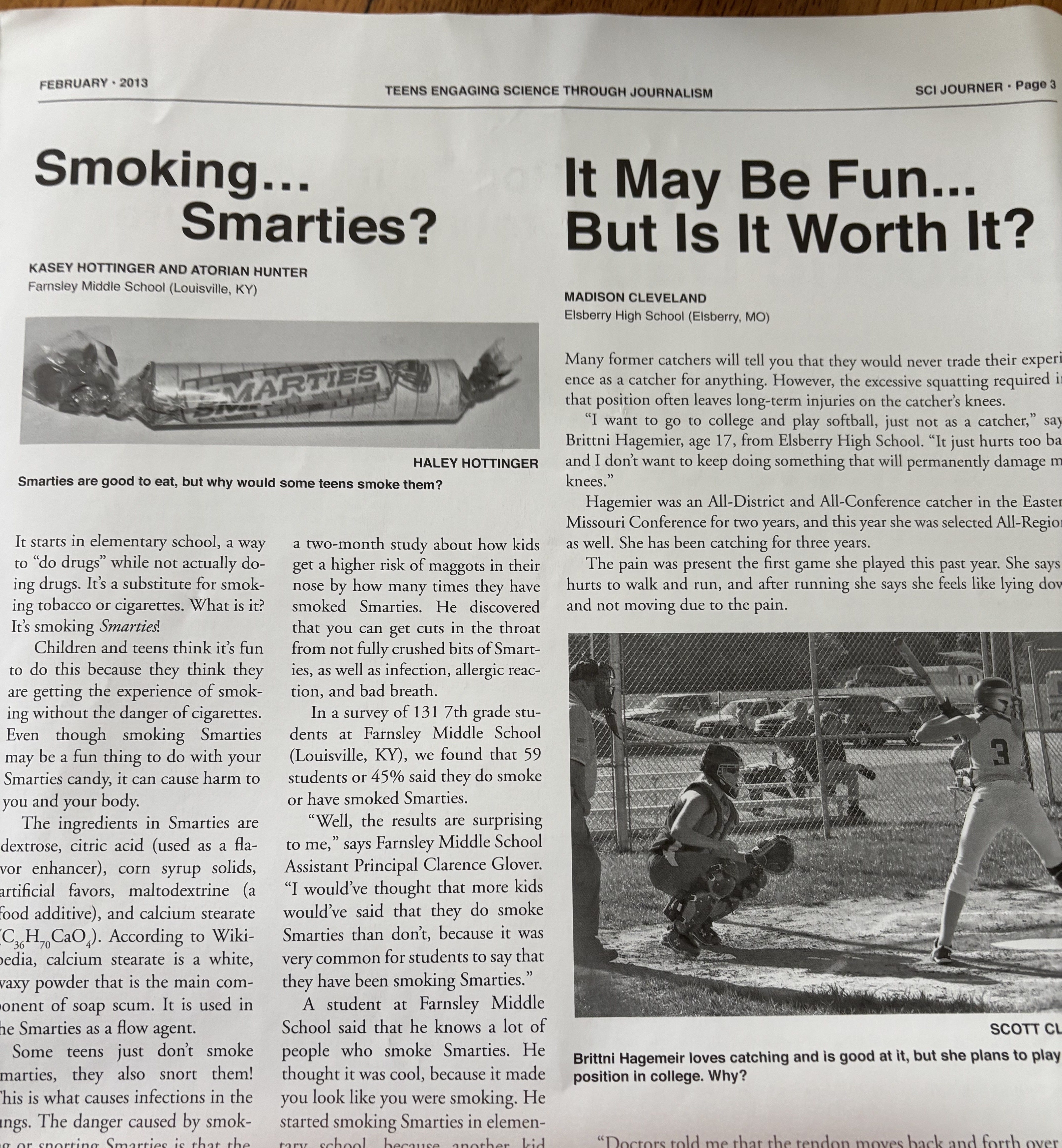
Today newspapers like those delivered to my childhood home by the paperboy or left at the door of JHS 22 or even those constructed through SciJourn are a rarity. Social media has had a devastating impact on news organization and even avid readers like me, who read their newspapers online. But there is an exception. If you live in a small town like ours, we wait for weeklies like the Bluestone Press or the Schwangunk News, sold in the local grocery stores, that report on people and places we all know about. We wait to see if the last Town Board meeting was summarized accurately. And the article about the Community Center: did they “get it right?” “Did you see the picture of you pulling tires out of the Rondout?,” I ask my husband.
But what I love most about these papers are our small town obituaries. They are luxuriously long and personally intricate. Bill Vanaver, someone I admired greatly but knew mostly from afar, died a few weeks ago. He was an age-mate of sorts—would have been a few years ahead of me if we’d gone to college together. In music genealogy Bill was related to Woody Guthrie and Pete Seeger on one side and a host of world folk musicians on the other. With his wife, Livy, Bill created a music and dance troupe, Vanaver Caravan, which had kids, including our across-the-street neighbor, performing to sell-out crowds. His obituary, instead of provoking anxiety, reminded me how lucky I am to live where I live. It also left me wondering if the seemingly easy music that flew from his magic fingers ever really dies. His life was indeed a blessing. Our local paper confirmed that fact.
 | A guest post by
|
PS. I had this discussion with my gerontologist and he concluded that my talking about my own death, I must be depressed. I assure you I am not.
Dear Wendy:
I am 84 and in poor heath, not a news reader after trump came along. I knew and admired Bill Vanaver...what an accomplished life and nice person.! When someone like Bill dies, I always wonder, why them instead of me.? I make up reasons; must have been a smoker, must have taken recreational drugs, must have led a life more stressful than mine. I have no reason to suspect any of these about Bill, but am wondering: what am I still doing here?