
Reading the Signs

On the drive home from New Paltz, about 25 minutes from our house, I begin counting the road signs: a squiggle showing the approach of a winding road, the ubiquitous stop signs, the word signs like “Children at Play,” “Railroad Crossing,” “Entering Rosendale.” I begin imagining a world without road signs and there it was, I remember the countryside in Liberia.
A rural road in Bong County provides a charming path through an unfamiliar and unadulterated landscape. Boys with schoolbooks jauntily slung over-their shoulders, ladies with groceries piled high on a donut-shaped cloth rings called a katas; people hoeing small vegetable garden plots. Small children play along the railroad tracks.
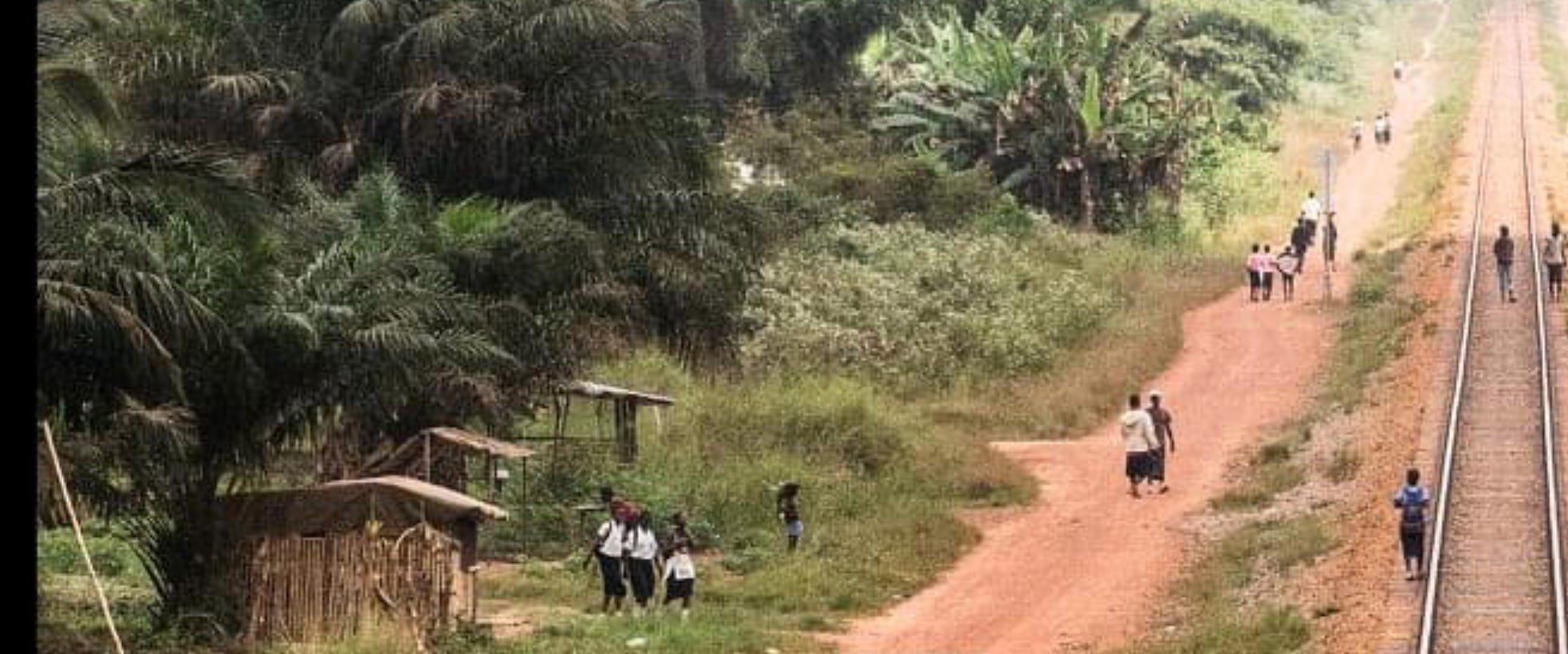
The railway bed was part of the old Liberia, the pre-War Liberia. Signs were not evident then, either, but the trains were smaller, slower, and less frequent. Then in 2005 ArcelorMittal, one of the largest steel producers in the world, saw an opportunity and leased mineral rights from the Liberian government. The iron ore, mined in Yekepa (Nimba County), is now carried by train on a 240 Km dedicated railway to the Port of Buchanan. The mega-project is a pillar of Liberia’s current economy.
With no regard to existing villages and populations, the Luxembourg-based conglomerate drew a straight line and rebuilt sections of the railway bed to efficiently meet their needs. Trains appear almost without warning, and numerous accidents occur as locals cross the tracks to get from one side of the village to the other. ArcelorMittal brags about improvements they have made to the tracks, replacing wooden ties with more expensive sleepers, and they complain vociferously about thievery as locals resell material pilfered from the tracks as salvage. Even when locals aren’t crushed by the trains, many accidents occur as residents jump from the tracks at the sound of oncoming engines.
In truth, unless you were there on the ground, you would hardly notice the dangers residents face. You need to be there to see and understand. With issues like this in mind, Scott Walter, then Executive Director of the Canadian ngo CODE, and I spearheaded a project called “Context Matters” in 2017. The program offered grants to indigenous researchers across sub-Saharan Africa. We prioritzed educational studies that attended to women and girls in fragile, post-conflict, and refugee communities.
To me, the best studies we received didn’t fit into the standard research paradigm- question, lit review, method, data, analysis-- used in PhD programs. The researchers I admired talked to girls, offering them anonymity; they asked questions and provided details. From these narratives I learned about the dangers girls face as they travel miles through the bush to get to school. At the end of the school day, after walking miles to get home, they begin the chores of drawing water and making dinner for their fathers and brothers.
Another shocking study from a Kenyan professor: We learned that families who struggled to send their daughters to all girls’ private high schools and then to a good University had no idea that their protected teenagers were communicating online with “sugar daddies,” older men who provided them with fancy clothes, dinner outings and apartment visits.
Were there obvious signs? Yes and no. Signs provide information but not reactions or solutions. Think of the improved train tracks and the contribution of ArcelorMittal to the Liberian economy, sure signs of growth and development. Then consider the lack of literal signs and crossing guards near the tracks. Consider the unmarked footpaths through the bush which students must traverse. Would signs help? What might protect the young female scholars, other than dropping out of school.
And the Kenyan University students? As a parent, we want the best for our children, but surely, not this. What signs indicate that a daughter is doing well? For the young victims of Jeffrey Epstein, I assume all the signs of success both attracted and intimidated the young women. There is so much to learn, so much that needs change.
The well-marked road signs in Ulster County, NY need attention and updating, just like the wished-for signs near the train tracks in Liberia. But other signs—no less important or evident—also need to be read. Our 13-year-old neighbor was always an engaged and cheerful sort, and is now, suddenly, is unable to look anyone in the eye. She seems continually on the verge of tears. What does it mean? I remember watching teachers at all-day workshops eat their prepared lunches—some pile plates high with food while others uncomfortably pick at a small sandwich. Their habits tell a story, although I am not sure about its contents. What does it mean?
There is the sign and there is the reader of the sign, the person who offers the sign and the person who tries to make sense of the sign. The sign lives in context, a context often hard to read from the outside.
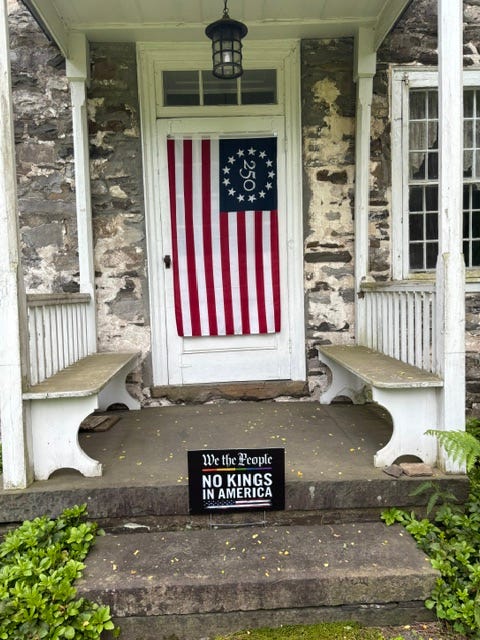
As residents of a very old house, we were offered a flag to celebrate the 250th year of the nation’s founding by our local Town. After equivocating about the meaning of the sign (what has happened to this experiment in democracy?) and what it would mean to say no, I did find a solution of sorts, at least to the signage problem.
.
What a beautifully woven piece, Wendy.
Thank you.