
Why Do I Care?
What If I Didn't?
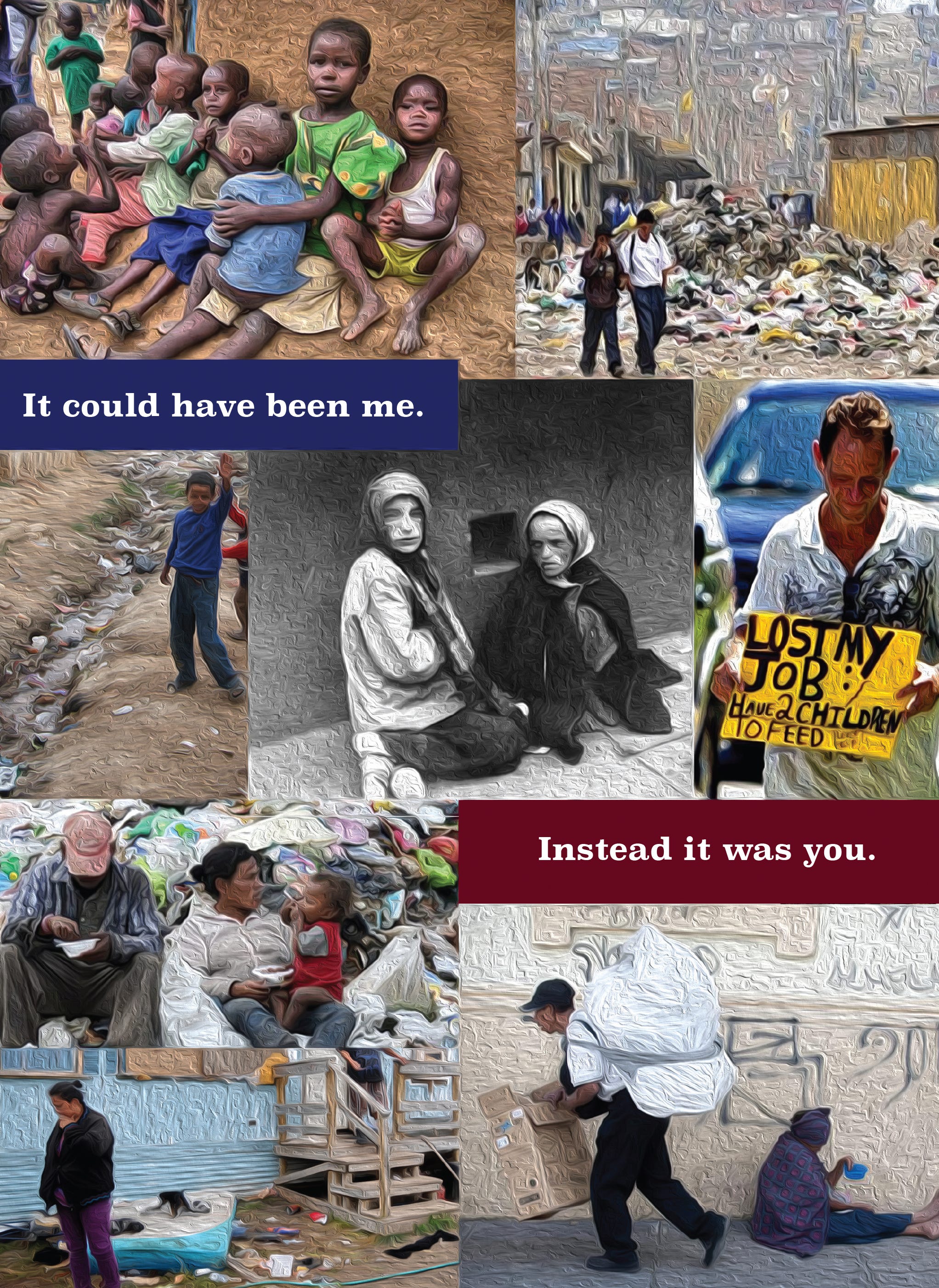
illustrations from my American Torah Toons 2
I had my annual physical this week and told my doctor, “So far, I’m an immortal” —meaning, I don’t yet know what my disease will be, I’ve not yet been diagnosed with a condition, I’m not taking any medications. When my blood work comes back next week, I expect to be in the safe range on every count.
This is not just a function of good luck. Nor of my genes. It’s as much a result of never doing physically punishing work in crappy environments; never going without food or medical attention; never living in a state of constant, inescapable anxiety, under a cloud of despair.
I’ve never been one of the four million American children — four million! — who are the prime or sole caretakers for their sick and disabled parent(s), as the New York Times reported this week. I’ve never been one of the 46 million Americans — 46 million! — who rely on food stamps and food pantries to meet their nutritional needs. I’ve never been one of 43.5 million American women who experience serious violence or stalking during their lifetimes from their husband or boyfriends. I’ve never been one of the 400,000 women and girls who are raped in our country each year.
All of this is why a white man like me, living on a bit less than the American median household income (but with no debt and no mortgage or rent), has a life-span advantage of at least seven years over poor men and women of every race.
And this upsets me. My well-being — or their lack of it — upsets me.
WHY? WHY DO I CARE? Why do I suffer from what Elon Musk absurdly calls “the fundamental weakness of Western civilization” — empathy?
I don’t know why. I seem to have been born this way and raised this way.
There are moments, for sure, when I wonder what it would be like not to care about what’s happening to other people . . . not to feel “lucky” but “deserving” . . . not to be scrupulous about treating people fairly , , , not to be upset by the news.
What might I have accomplished if I had been unleashed from my conscience? If I had focused only on cultivating my own exceptionalism in a society that makes such a big whoop about exceptionalism?
In those idle moments, I again realize that unless we are sociopaths, the effort of avoiding empathy requires us to pervert ourselves with theories that blame the victims, laud the lucky, despise the “other,” and idolize power. Those are the theories that arise in my mind when I contemplate extinguishing my empathy.
I want none of that, which is why I would still call myself a “social-ist” — with a hyphen. Marxist theory, pooh. Dictatorship of the proletariat, fuggetaboutit. Still, I take seriously the reality of human interdependence, the reality that produces babies and civilizations. I am a social-ist because I want to see policies that cultivate and build upon that reality in our lives.
Musk’s denunciation of empathy is, in fact, what established his fascist bona fides for me, even more than his loony Nazi salute. It was Adolf Hitler, after all, who identified the “Jewish virus” to be compassionate ethics, which, he believed, had corrupted the will to brutalize and dominate that was needed for the “Aryan” race to thrive.
Forgive me for sounding reductionist, but the struggle in which we are engaged IS about social-ism versus fascism. It’s an ideological struggle far older than the United States. And right now — for the time being — we’re losing it.
……………
Below find a poem that’s making its rounds on the internet. It’s long but it’s also deep, full of good moments, and worth your time:
TO REMAIN HUMAN
by Brian Lewis
The nervous system
was never designed
to carry the grief
of an entire planet
Yet here we are
A child starving
crosses our screen
between weather reports
and advertisements
Forests burn beside stock prices
Wars arrive
in the same hand
that holds photographs
of our grandchildren
And somewhere inside us
something ancient
keeps trying
to respond
This is the exhaustion
few know how to name
Not simply stress
Not simply fear
But the unbearable collision
between the human heart
and the scale
of modern awareness
We were meant
to know the sorrow
of the village
Now we are asked
to metabolize
the suffering
of civilizations
And many are drowning
Some in rage
Some in distraction
Some in endless performance
Some in irony so thick
it becomes a shield
against feeling anything real
Others quietly disappear
inside themselves
their spirits dimming
beneath the constant demand
to remain informed
productive
available
certain
The world keeps shouting
Choose a side
Move faster
Consume more
Outrage harder
Win
But the soul
does not speak
in that language
The soul speaks
through silence
through grief
through awe
through the sudden trembling
that arrives
when one human being
finally feels
the reality
of another
This is why
so many people
stand at the edge
of breakdown
Not because they are weak
But because they are porous
Because somewhere beneath
the armor
their humanity
is still functioning
And perhaps
that is what must now
be protected
Not merely ecosystems
Not merely institutions
But the fragile interior capacities
that allow human beings
to remain human
inside an age
that profits from fragmentation
To remain tender
without collapsing
To remain informed
without becoming consumed
To remain compassionate
without surrendering discernment
To stand before suffering
without turning away
and yet also
without allowing suffering
to transform the heart
into stone
This is harder
than revolution
Harder than ideology
Harder than certainty
Because it asks something
few civilizations
have ever learned to cultivate
strength
without cruelty
Perhaps this is why
small acts matter so much now
A hand on a shoulder
A teacher
who notices the silent child
A man planting trees
whose shade
he will never live to sit beneath
A woman refusing
to let cynicism
be mistaken for wisdom
These are not small things
They are the architecture
of psychological survival
The architecture
of repair
And maybe the future
will not ultimately be decided
by those
who accumulated the most power
but by those
who learned
how to carry immense complexity
without surrendering
their capacity
for love
Because civilizations do not die
only from invasion
or collapse
They also die
when people can no longer feel
one another
When exhaustion
becomes identity
When distraction
becomes culture
When tenderness
becomes embarrassment
When the human nervous system
finally says
enough
But I do not believe
that ending
is inevitable
I think there are still people
quietly rebuilding
the interior world
Still people
teaching children wonder
Still people
protecting beauty
Still people
who understand
that compassion
is not sentiment
It is infrastructure
And perhaps
the task before us now
is not merely
to save the world
but to become
the kind of people
capable
of inhabiting it together
……………
Please visit the ALTE website to view our issue #17, on the theme of “Crossing.” (Do it on a computer, not a phone, for optimal viewing.)
Thanks for this. I count on your wise words and good works. As I read today's piece, I couldn't help but think: "Why don't so many of our fellow Jews care more? About the people in Gaza? The people in the West Bank? The Arabs within the state of Israel?" Our religion, our history, our culture all teach us that every life matters. And yet... I would have said I cared because I was raised a Jew. And yet...
Ah, thank you so much for all your thoughts and words and for the marvelous poem!