
After Life

Do you ever think about what’s going to happen to your stuff after you die. I suppose that’s a subset of wondering about what will happen generally after we die. But the specificity of personal belongings encourages a particular sort of morbid contemplation.
When I say stuff, I don’t mean furniture and tchotchkes. If my children, or whomever is around to administer my estate, does not want chairs, sofas, tables, lamps, dishes, silver, etc., etc., give those things away, sell them or throw them out. My children have their own things, their own taste. My things are not me. I don’t want them to feel burdened or guilty. I hope they think of Freecycle or Goodwill or a yard sale or a dumpster as a friend. I know photos may end up in the trashcan.
But what about the shelves filled with journals in which my poems, articles and reviews appear? It has taken me decades to amass those publications. And then there are my notebooks. Dozens of them. I’ve been keeping a journal for more than fifty years. I write almost every day. Before laptops or tablets or smart phones, I filled pages and pages with pen and paper. I still do. They are all sizes, all colors, though almost all have lined paper. I don’t doodle. I don’t draw. I write, and my handwriting is atrocious. I’ve gotten many blank notebooks as gifts and bought more when I travel. School notebooks, too, are wonderful
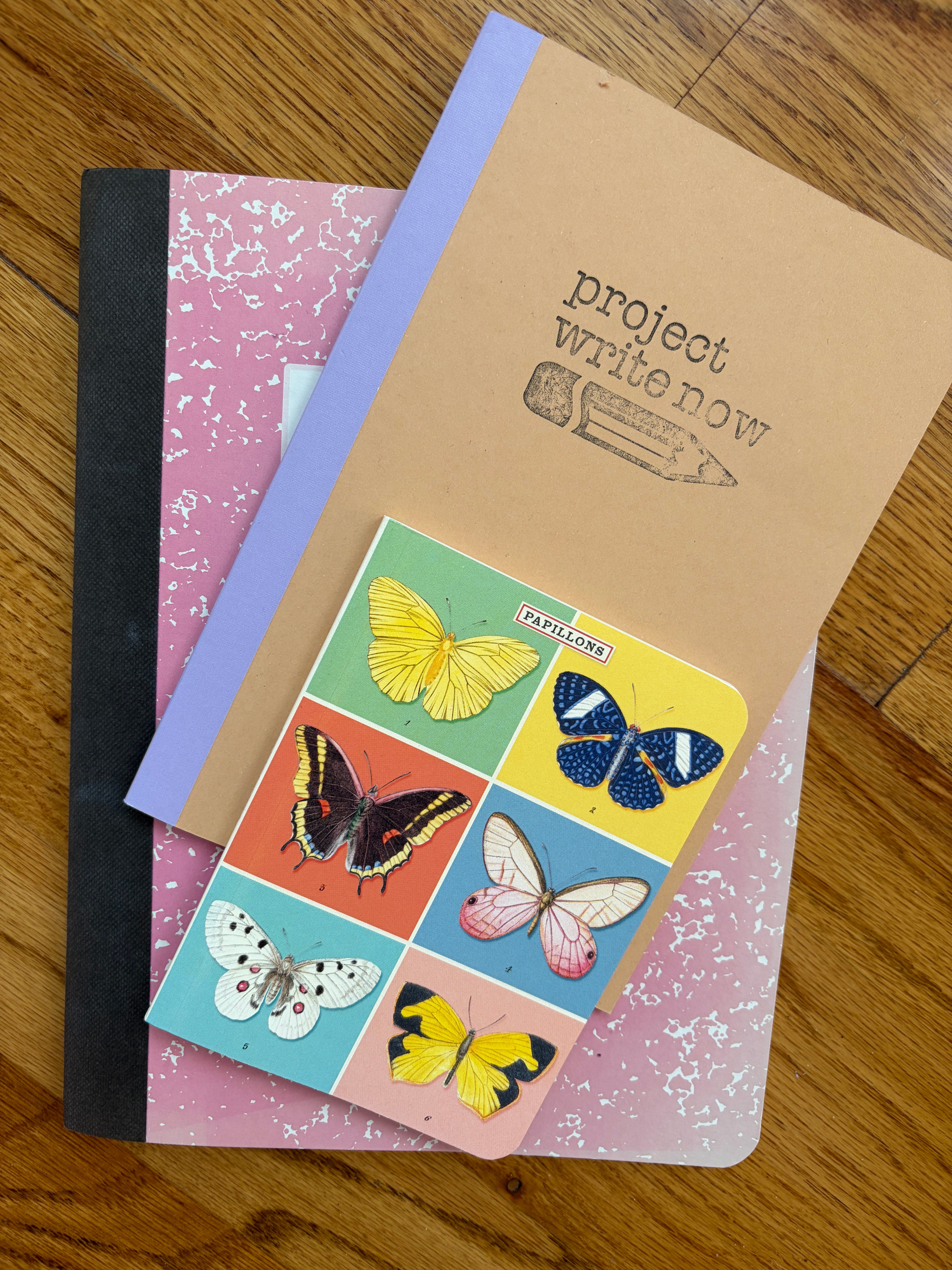
.
My daily journal entries are written entirely by hand. Most are not interesting, often as mundane as what I ate for breakfast, or what tasks need to get done. I write about problems with my pen or whether I have too many notebooks going at the same time. Since I am left-handed, ink splotches garner comments. Sometimes I add scrapbook items like programs, or ticket stubs or news clippings.
My journal writings are not like Julia Cameron’s recommendation of “morning pages” in The Artist’s Way. Hers are more prescriptive as to length and subject matter. Mine are kind of similar. They work for me. Her book is a terrific tool. When people ask me if I write every day my response is, “no.” But that’s not true. I do not write or revise a poem or a review or an essay every day, but I do write in my journal. If I miss a day I feel at loose ends. The feeling abates when I sit down to write again.
In the years I worked full-time, I journaled during interminable meetings and hearings. I commented on the participants or the agenda, or whatever was on my mind. Snapshots of history.
I write when I travel. I write to remember. I write to work through feelings and ideas. Many of my notebooks include early drafts of poems or essays, though, over the years, I have trained myself to write on my laptop. It’s a less satisfying experience than pen and ink.
I wonder whether my children or anyone will read the notebooks. What will they think? I rarely go back and read them myself. And if someone does read them and discovers something revealing, how will that matter? What could I reveal about myself that’s a mystery? And if no one reads them, that also will not matter. I will not know. I will not care.
Maybe my children will hang onto a few as keepsakes. I have their father’s pen and his notebooks. That will be their problem too. And if my laptop eventually gets wiped, and my notebooks and journals and books get recycled. So be it. None of us lives forever.
ALTE, #17, Crossing is out! Hope you’ll take a look.
What happens to our words? Love this x
My plan is to have all of my created stuff — books, artworks — at my funeral/memorial and ask attendees to take something home with them. But who knows how many people will be at my funeral?